
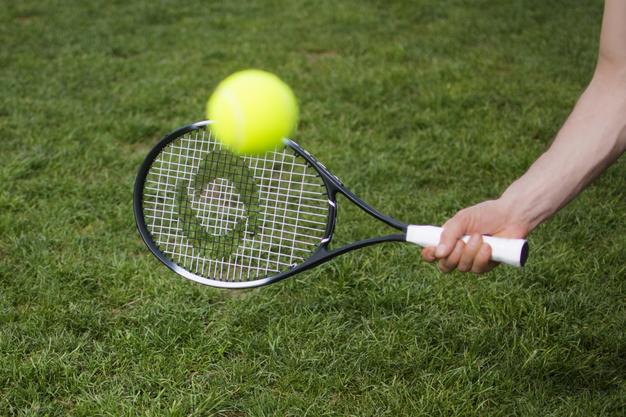
Anyone who thought that grass could only be found on soccer fields is very much mistaken. In fact, grass is the original tennis surface, as seen, for example, on the historic Wimbledon court. However, nowadays more tennis courts are built using artificial grass or ReinGreen® (a registered trademark of Reindesa) foam fiber, as they are more economical to maintain and more durable, although this surface is less common than other types. Keep reading to learn more about this type of court!
NATURAL OR ARTIFICIAL GRASS?
Natural grass is one of the three surfaces used in official tournaments, along with clay and hard courts. It results in a fast-paced game, primarily featuring a serve-and-volley style with an erratic bounce —characteristics that artificial turf also offers. Naturally, natural grass requires more extensive and costly maintenance than artificial turf, including regular mowing and watering. For this reason, natural grass courts are practically nonexistent in Spain, unlike in Great Britain.
Tennis courts are currently being built with artificial turf backfilled with silica sand, which provides a surface with long-lasting durability and low maintenance costs. In fact, artificial turf can have an average lifespan of 7 to 10 years; it is resistant to periods of rain or drought and can withstand heavy foot traffic and friction, whereas natural grass deteriorates after just a few matches.
To install artificial turf tennis courts, the turf is laid over a rigid subbase and then finished by adding infill and a layer of rounded silica sand with a controlled particle size distribution. Finally, we brush the court so that the sand settles between the fibers.
REINGREEN®: THE NEXT-GENERATION ARTIFICIAL TURF
Reindesa’s trademarked ReinGreen® looped pile, certified by the ITF (International Tennis Federation), could be considered an advanced form of artificial turf. Although it is made from the same basic material and also requires minimal maintenance, the way it is woven and its finish make it comparable to the performance of clay courts. It provides a high, slow bounce, controlled player movement, and greater joint protection thanks to its intermediate membrane.
In addition, it is highly recommended for extreme climates, due to its resistance to low temperatures, and for restoring damaged surfaces.
KEY BENEFITS
a) Very low maintenance and long lifespan: annual maintenance is all that’s needed. The grass always stays green, there’s no need to sweep, and it’s wear-resistant.
b) It does not stain the players’ clothes or shoes. We’ll prevent the sneakers from taking on the greenish tint that typically results from rubbing against natural grass.
b) Enjoyable and flexible gameplay. Anyone can play on courts like this. They mimic the characteristics of hard courts, offering good traction, a natural feel underfoot, and quick ball response. Slice backhands can be deadly to your opponent because the ball is harder to lift.
c) Player safety. They feature an effective drainage system to remove water in case of rain or humidity, preventing the surface from becoming slippery. They can also reduce the risk of injuries and scrapes from falls.
d) Renovations and minor repairs. It allows for selective renovations in certain areas of the track (backstops, etc.)
SOME DISADVANTAGES
a) The ball bounces unevenly, and it can be difficult to get the ball up: Although the surface is designed to mimic hard courts, it’s made of synthetic fibers, so the ball may not bounce as high. That’s why flat, powerful serves and volleys predominate, with players focusing on shorter rallies.
b) Joints may be affected: A low bounce requires a faster stroke, and at high speeds, we may not hit the ball with the sweet spot of the racket (where the ball is struck with the greatest control and power).
c) If the sod isn’t laid perfectly, it will show. There should be the right amount of sand, and the surface should be “smooth,” without any unevenness, to ensure a good playing experience.
Are you thinking about building an artificial grass tennis court? Request a quote online by click here!