
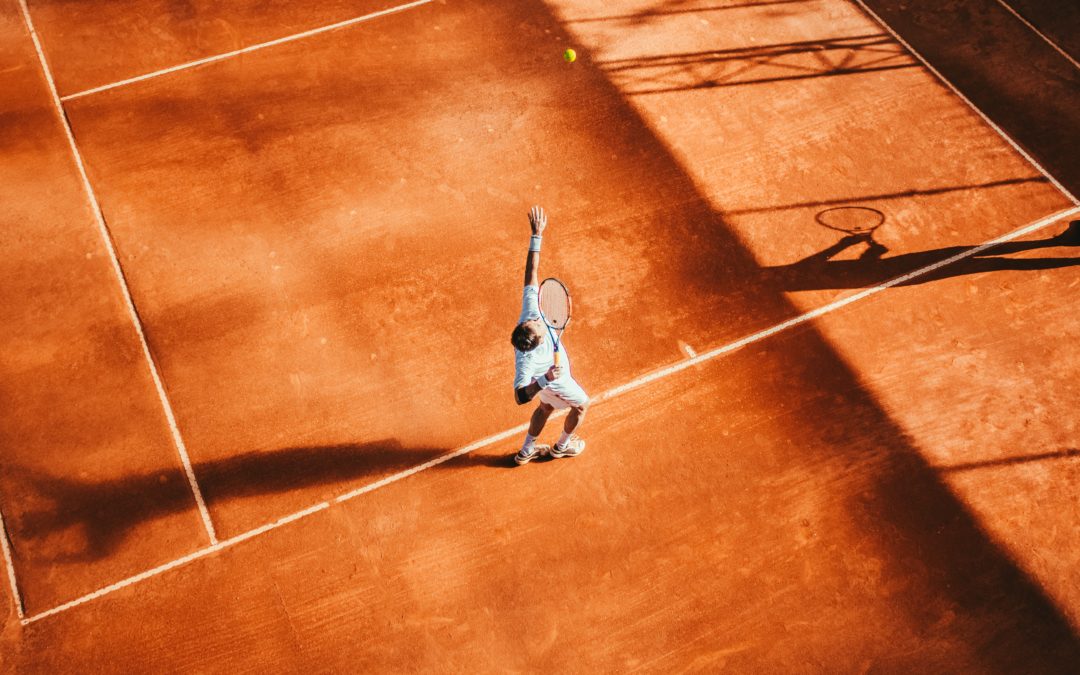
As one of the most common types of tennis courts in Spain, clay courts simply had to have their own blog post dedicated to them. In addition, this type of court is the one found at tennis clubs and at major tournaments such as the Roland Garros Grand Slam, the Mútua Madrid Open, and the Monte Carlo Masters.
Primarily, in terms of gameplay, clay courts produce slow bounces and a lot of slide, resulting in a more defensive and sustained style of play from the baseline, with longer rallies. Would you like to know more about this type of track? Keep reading!
WHAT ARE THEY MADE OF?
As the name suggests, clay tennis courts are made of clay and brick dust ( hence their reddish color). This clay is obtained from quarries and must be fired in kilns at temperatures between 750 and 950 degrees. It is then ground into a layer about 10 mm thick, with grains ranging in size from 0.6 to 1.3 mm. Approximately 500–1,000 kg of clay will be needed for one court.
But these courts aren’t made entirely of clay; in fact, there are two more layers beneath it. The bottom part is called a “slab”or mortar, a hard surface onto which the clay will be applied. On top of this is the so-called “sealer,” which is essentially a mixture of compacted soil and adhesive, and serves to prevent holes from forming on the surface when the ball bounces or if players slip. In addition, its surface drains very well.
Clay tennis courts are relatively inexpensive to build, but they require a lot of maintenance, including daily watering and raking to keep the surface in good condition, unlike other types of courts, such as those made of artificial turf or asphalt.
KEY BENEFITS
- A slower, higher-bouncing ball makes for a more comfortable and defensive game, with more dynamic plays.
- Fewer injuries for players, because the glide provided by this type of court prevents very sudden stops.
- There’s no problem with the high temperatures on fast courts when the heat is intense, because clay courts require watering, and as they get wet, the heat subsides.
- Because the surface drains so well, even if it rains lightly, we can keep playing without the risk of slipping, as would happen on hard courts.
SOME DISADVANTAGES
- They require more frequent and consistent maintenance than other types of courts, especially before a match. Otherwise, holes and uneven spots may appear where the ball bounces or the player steps.
- They require greater physical endurance from the players, because there are more exchanges during the game.
- The ball’s slower speed and greater height cause matches to last longer and, as a result, players tire more quickly.
- By their very nature, these are tracks suited for sunny or coastal locations, not for areas with severe weather conditions.
Are you thinking about building a clay tennis court? Request a quote online by clicking here!